
When should you use the circular method?
The circular method solves a practical problem every oyster farmer knows: uneven batches. When bags remain static or are turned irregularly, oysters grow unevenly — shells become elongated, sizes vary, and end-of-cycle grading ties up time and labour.
Continuous rotation eliminates this problem at the source. Every oyster receives the same tumbling, under the same conditions, throughout its growth. The results are visible within the first few months: uniform batches that require less grading and a compact shell that withstands transport better.
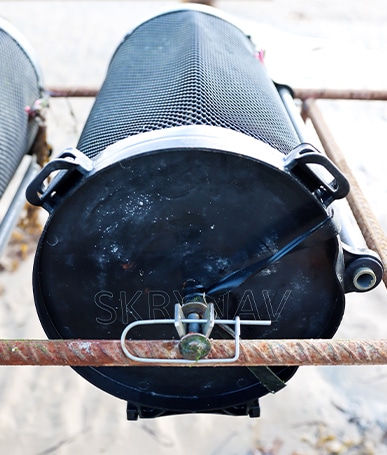
Situations where the circular method is particularly effective
- Farms in areas with strong swell or a large tidal range : rotation naturally intensifies with sea conditions
- Farmers aiming for a fine-grade or spéciale-grade oyster with a round shell : shaping begins at the juvenile stage
- Sites where biofouling (algae, barnacles) slows growth : continuous rolling limits organisms settling on the shells
- Farms short of labour for regular bag turning : the system works with every tide, with no intervention
How does SKRYNAV circular growing work?
SKRYNAV introduces to Europe the first circular growing system built into an oyster trestle. The mechanism is based on the patented cylindrical bag (INPI FR2606484), mounted on a stainless steel axis (SKNTIGE) that runs right through the bag.
- The bag rotates under the action of swell, tide and waves: the oysters tumble against each other continuously, with no human intervention
- Natural seawater lubrication of the stainless steel axis ensures smooth, maintenance-free rotation
- Rubber grommets protect the bag and cushion friction
- The SKRYNAV cylindrical bag is available in 4 mm (BSN4), 6 mm (BSN6) and 9 mm (BSN9) mesh sizes, from spat to market size
The growing cycle with the circular method
A single structure takes the oyster from spat to market size.
Farmers adapt the mesh size of the SKRYNAV bag to each phase, without changing trestle or method.
Nursery stage (0 to 8 months) : Moderate rolling guides shape from the juvenile stage. The shell begins to round out and batches even out naturally. BSN4 bag (4 mm mesh).
Grow-out (8 to 24 months) : Continuous rotation strengthens the shell and produces fine-grade or spéciale-grade oysters with a regular shape. Biofouling is reduced by constant movement, freeing up natural filtration. BSN6 bag (6 mm mesh), then BSN9 (9 mm mesh).
Finishing (24 months and over) : Gentle rolling maintains high meat yield and preserves taste quality. Fleshy end-of-cycle oysters retain their condition index thanks to moderate tumbling.
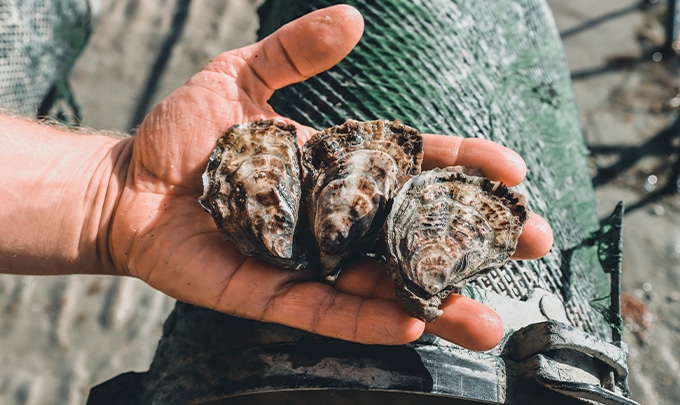
The circular method: the results on your oysters
The circular method turns every tide into a workforce. The results can be seen directly in the batches:
- Round, compact shell : Repeated friction removes irregular growth and hardens the nacre from the first months of growth
- Uniform batches : Even tumbling reduces size variation and cuts grading time before shipping
- Enhanced growth : Rolling reduces biofouling, frees up the oyster’s filtration and promotes natural nutrient intake
- Reduced juvenile mortality : Continuous movement limits heat stress by spreading exposure, improving spat survival during the summer
Equipment for the circular method
The circular method works with standard SKRYNAV equipment
No additional accessories are needed — rotation is the system’s native mode.
- TSN6B (6-bag) or TSN8B (8-bag) oyster trestle : steel frame with stainless steel bars
- SKRYNAV Bag : BSN4, BSN6 or BSN9 depending on the growth stage
- SKNTIGE stainless steel rod (Ø 10 mm) : patented rotation axis, resistant to saltwater corrosion
- 316L or 304 marine-grade stainless steel components (EN 10088-3 standard)
Designed by Alexandre Navarre, marine biologist and oyster farmer in Gouville-sur-Mer, the SKRYNAV bag was developed and tested directly in the field, facing the Normandy tides. Proven robustness on the most exposed oyster leases in Normandy.
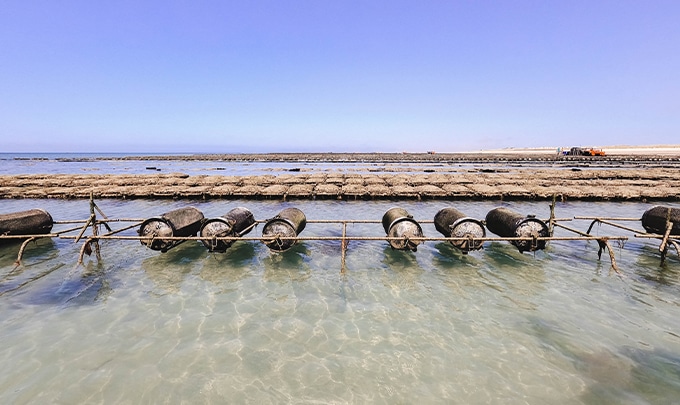
SKRYNAV : Precision oyster farming
A system designed for every oyster farmer
Other SKRYNAV growing methods
The SKRYNAV trestle supports three methods on the same structure. Farmers switch between them according to the season and their production goals.
Oscillating Method
Intensive shaking for a premium oyster
The kinetic energy of the tides, amplified by a float, generates intensive shaking that hardens the nacre and develops the adductor muscle beyond industry standards. The method of choice for farmers targeting premium markets and long-haul export.
Flat Method
Traditional hardening, modernised
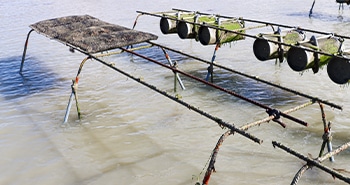
Emersion cycles concentrate flavour, harden the shell and extend shelf life out of water. The oyster farmer’s time-honoured craft, built into the SKRYNAV system with no compromise.
Integrating SKRYNAV into your oyster farm
SKRYNAV is professional equipment designed to adapt to every farm. Sea conditions, production goals and growing practices vary from one site to another: a direct conversation allows us to define the configuration best suited to your situation.
Contact Domaine Navarre for a personalised consultation: technical presentation, on-site trial or quote request.
