
When should you use the flat method?
Hardening is the oldest technique in oyster farming: exposing oysters to the air to firm up the meat, harden the shell and condition the product for shipping. It is a skill every professional masters, and one that makes all the difference to the final quality of the oyster.
The problem with conventional systems: hardening often requires transferring stock between structures. Traditional flat bags are not compatible with tumbling systems. Farmers have to manage two sets of beds, two types of equipment and two logistics chains — wasted time and extra handling.
With SKRYNAV, hardening is built into the same equipment: a single stainless steel bar is all it takes to switch from circular or oscillating mode to flat mode. The oysters stay in their bag, on their trestle, with no transfer and no handling.
Situations where the flat method is particularly effective
- End-of-cycle finishing (affinage) : emersion cycles firm up the meat and develop the briny aromas characteristic of each merroir
- Pre-shipment conditioning : an adductor muscle trained to stay closed during emersion ensures superior shelf life out of water
- Winter holding : the horizontal position keeps oysters stable, reduces physiological stress and protects the stock
- Export production : extended shelf life is a decisive criterion for long-haul shipments (48 to 72 hours)
How does SKRYNAV hardening work?
The principle is simple and true to tradition
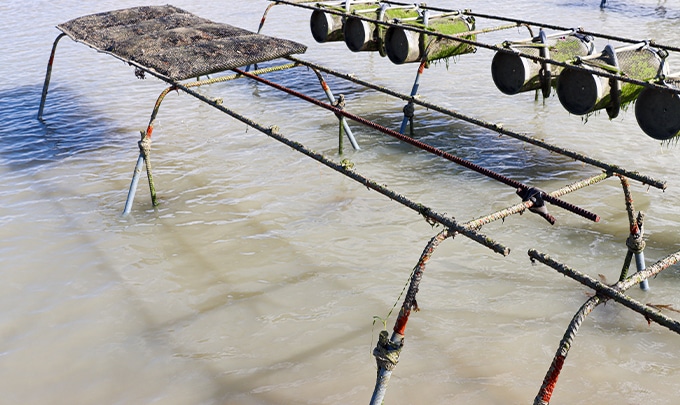
The SKRYNAV bag lies horizontally on the trestle bars, held in place by a steel retaining bar. With every tide, the alternation between air and sea reproduces the natural emersion cycle that defines hardening.
- Built-in hardening: the SKRYNAV bag lies horizontally on the steel bars supplied with every trestle — no complex handling and no extra accessories
- Controlled emersion cycles: alternating air and sea exposure increases meat yield and develops the characteristic aromas of open-sea oysters
- Instant switchover: move from circular or oscillating mode to flat mode in seconds, on the same SKRYNAV trestle
- No transfer between structures: the oyster stays in its bag throughout the cycle, from grow-out to shipping
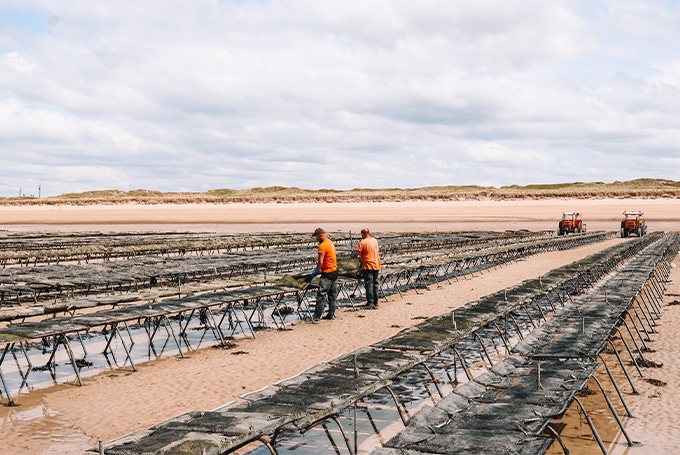
When to use the flat method in the growing cycle
The flat method comes into play at the stages where stability matters more than movement. It complements the circular and oscillating modes within a complete growing cycle managed on a single trestle.
Finishing (from 24 months) : Emersion cycles firm up the meat, maintain a high condition index and develop the briny flavour and umami notes characteristic of each oyster-growing merroir. Finishing with the flat method showcases the identity of your growing area.
Holding and shipping (year-round) : The horizontal position keeps oysters stable, reduces physiological stress and extends shelf life out of water. The product stays fresh for longer after harvest — a direct advantage for shipments within France and worldwide.
SKRYNAV hardening: the results on oyster quality
SKRYNAV hardening preserves all of the oyster farmer’s know-how while simplifying logistics.
One trestle, one bag — no transfer between structures, no extra equipment.
- Premium meat yield : Controlled emersion cycles concentrate the visceral mass and maintain a high condition index, the hallmark of a spéciale-grade oyster
- Shell hardened by emersion : Regular air exposure strengthens the nacre and mechanical resistance, reducing breakage in transit
- Extended shelf life : An adductor muscle trained to stay closed during emersion ensures superior keeping quality and longer-lasting freshness after shipping
- Concentrated flavour : Hardening develops the briny aromas and salinity characteristic of each oyster-growing merroir, showcasing the identity of the growing area
Equipment for the flat method
The flat method uses standard SKRYNAV equipment plus the hardening bar included with every trestle. No additional investment required.
- TSN6B (6-bag) or TSN8B (8-bag) oyster trestle : supplied with the stainless steel hardening bar (Ø 10 mm), ready to use
- SKRYNAV Bag : 36-litre capacity per bag, suited to finishing uniform batches, from fine-grade to spéciale-grade oysters
- 316L or 304 marine-grade stainless steel components (EN 10088-3 standard) : complete resistance to saltwater corrosion, even in prolonged static position
La poche cylindrique maintenue à plat protège les huîtres du roulement et limite le stress physiologique : une configuration idéale pour le stockage hivernal et l’affinage de fin de cycle.
SKRYNAV : Precision oyster farming
A system designed for every oyster farmer
Other SKRYNAV growing methods
The SKRYNAV trestle supports three methods on the same structure. Farmers switch between them according to the season and their production goals.
Circular Method
Moderate tumbling for uniform batches
Gentle, continuous rotation driven solely by the tides shapes round, regular shells from the juvenile stage onwards. The benchmark method for the nursery phase and for achieving uniform grading.
Oscillating Method
Intensive shaking for a premium oyster
The kinetic energy of the tides, amplified by a float, generates intensive shaking that hardens the nacre and develops the adductor muscle beyond industry standards. The method of choice for farmers targeting premium markets and long-haul export.
Intégrer SKRYNAV dans votre exploitation ostréicole
SKRYNAV is professional equipment designed to adapt to every farm. Sea conditions, production goals and growing practices vary from one site to another: a direct conversation allows us to define the configuration best suited to your situation.
Contact Domaine Navarre for a personalised consultation: technical presentation, on-site trial or quote request.
